February 28, 2026
The United States of America was forged in the meeting halls and on the battlefields of the American Revolution, which established our republican form of government and committed the new country to ideals of liberty, equality, natural and civil rights, and responsible citizenship. Over eight long years, the Revolutionary War was fought across large swaths of North America and beyond. It touched the lives and families of nearly everyone in what would become the United States, yet the full scope of who participated in our Revolution and the effects it had on those who fought in it remains less understood.
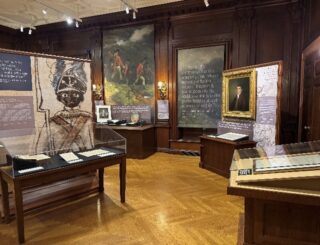
Voices of Revolution is on view through January 10, 2027.
In 2026, as our nation marks the 250th anniversary of the Declaration of Independence, the American Revolution Institute’s special exhibition, Voices of Revolution, shares the stories of those who participated in the war alongside the document that gave their cause a raison d’être—a rare copy of the Dunlap Broadside of the Declaration of Independence, on loan from the Society of the Cincinnati in the State of New Hampshire.
The exhibition draws from the collections of the American Revolution Institute as well as other museums and private collectors to feature the complex and compelling stories of more than a dozen individuals who participated in the Revolutionary War in different ways and on different sides of the conflict, as a soldier, sailor, laborer, or observer. It highlights the human experience—what individuals saw and did, where they came from and why, how the war impacted them, and how they impacted the war—using their words, belongings, and likenesses. These individuals’ wartime experiences—at well know battlefields like Yorktown and Brandywine and lesser-known engagements like Young’s House, New York, and Pensacola, Florida—emphasize the humanity of the event at the heart of our national identity.
Among the treasures on display in the exhibition is the Dunlap Broadside, the first printed version of the Declaration of Independence. Printed on the night of July 4, 1776, by John Dunlap of Philadelphia, this broadside helped spread the news of the united American nation and its Declaration of Independence. The rare copy on display in the exhibition until May 12—originally sent from Congress to Exeter, New Hampshire—is one of only twenty-six Dunlap Broadsides known to survive.
Other highlights of the exhibition include the observations of French engineer François-Ignace Ervoil d’Oyré on the Siege of Yorktown in 1781, a victory resulting from the critical Franco-American alliance; an oil portrait of Continental Navy officer Silas Talbot; accounts of the imprisonment of Col. Mordecai Sheftall, the highest-ranking Jewish officer of the Continental Army, after the British capture of Savannah in 1778; a portrait of Joseph Townsend, a Quaker civilian, and his account of the Battle of Brandywine in 1777; documents revealing the service of Black soldiers in the First Rhode Island Regiment; an account of the Battle of Germantown in 1777 written by British officer Thomas Musgrave; and weapons used by American Loyalist troops.
An accompanying digital interactive brings in more stories of Revolutionary War participants at battles across North America, giving visitors more opportunities to find someone whose revolutionary experience resonates with them. Together, these stories offer a broader picture of the kinds of people—American, French, British, Loyalist, Female, Black, Native American, German, Spanish—who took part in the American Revolution and underscore the meaning of our national motto: E Pluribus Unum…Out of Many, One.
Learn More About the Exhibition