The American Revolution Institute has acquired a rare January 5, 1775, issue of The Massachusetts Spy, one of the most important Patriot newspapers published in the months immediately preceding the American Revolution. Printed in Boston by Isaiah Thomas, the paper features Paul Revere’s celebrated “Join, or Die” masthead, among the most recognizable political images of Revolutionary America.
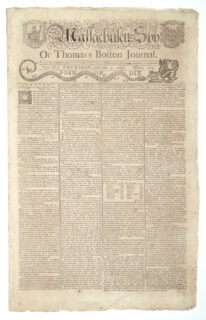
The Massachusetts Spy, or Thomas’s Boston Journal, January 5, 1775. Gift in honor of Thomas Hillery by his second great grandson Thomas H. Hillery.
First introduced in The Spy in July 1774, Revere’s masthead transformed Benjamin Franklin’s earlier “Join, or Die” cartoon into a forceful statement of resistance to British authority. Franklin first published the image in the Pennsylvania Gazette on May 9, 1754, as delegates prepared to meet at the Albany Congress to discuss colonial defense and Franklin’s proposed plan for intercolonial union during the French and Indian War. The segmented snake originally warned Britain’s colonies to unite against French power in North America, but it also gave visual form to a larger political idea: that the colonies could be imagined and addressed as a single political community.
Twenty years later, Revere adapted that older symbol of imperial coordination for a new crisis, transforming Franklin’s call for colonial union into a Patriot emblem of resistance to British coercion. The image depicts a segmented snake confronting a threatening griffin, with the colonies represented as separate sections of the serpent beneath the stark warning: “JOIN, or DIE.” By early 1775, the symbol no longer expressed loyalty to the British Empire or unity against France, but unity against imperial authority itself. Revere’s adaptation reveals how symbols originally created to strengthen the British Empire could be repurposed into arguments for resistance against it.
The newspaper demonstrates how print functioned as a revolutionary medium in eighteenth-century America. Printed on inexpensive paper intended for rapid circulation and collective reading, newspapers like The Massachusetts Spy carried political imagery into taverns, coffeehouses, homes and public spaces throughout British North America. Appearing prominently above the title each week, Revere’s engraving gave the newspaper an unmistakable political identity and transformed it into a medium of visual persuasion. Repeated issue after issue, the masthead became a recognizable visual signature of Patriot resistance.
Working as both artisan and propagandist, Revere adapted and circulated political imagery through the ordinary channels of newsprint, helping turn the newspaper into an instrument of propaganda as well as information. Long before later generations celebrated his midnight ride, Revere had already demonstrated the political power of engraved images with his famous 1770 depiction of the “Bloody Massacre” in Boston, and his masthead for The Massachusetts Spy carried that practice into the weekly rhythms of the Patriot press. In an age when newspapers circulated rapidly through taverns, coffeehouses and shared reading networks, readers experienced distant political events as part of a shared and unfolding continental crisis. Through newspapers like The Massachusetts Spy, colonists increasingly came to imagine themselves as participants in a common political struggle. The contents of the January 5, 1775, issue reflect the accelerating movement toward revolution. Reports printed in the paper describe militia organization in Maryland and resolutions supporting Massachusetts Bay, while other articles attack Loyalist printer James Rivington and document Boston town meetings that elected Samuel Adams, John Hancock, Joseph Warren and others to an extra-legal provincial congress. Together, these reports show how newspapers transmitted not only news, but also visual rhetoric, shared political identities and calls to collective action across an expanding colonial print network in the final months before open war.
This newly acquired issue preserves a remarkable convergence of political imagery, print culture and revolutionary communication at a pivotal historical moment. Combining one of Paul Revere’s most famous engravings with reporting from the edge of revolution, the newspaper offers an extraordinary window into how print and visual culture helped transform colonial resistance into a shared revolutionary movement. The Massachusetts Spy was acquired in honor of Thomas Hillery by his second great grandson Thomas H. Hillery.
Thomas G. Lannon
Library Director