The Battle of Brooklyn, fought on August 27, 1776, was the first full-scale land battle of the Revolutionary War. It was also a disaster that nearly destroyed George Washington’s army only weeks after the Declaration of Independence. Yet J. Michael Phelps argues that the battle has not simply been misunderstood. It has been only half covered.
In his new book, Squandered Valor: The Untold Story of Battle Hill and the Battle of Brooklyn, Phelps reexamines one of the most important and neglected episodes of the battle: the fighting on what is now known as Battle Hill, the highest point in Brooklyn. There, a force of about 300 men under General Samuel H. Parsons, primarily soldiers of the 17th Connecticut Continental Regiment, captured and held the summit against repeated British counterattacks. Providing specifics of the casualties from the reports of the British themselves, Phelps demonstrates that the fighting on Battle Hill produced more British deaths than any other location on the battlefield. Yet for nearly 250 years, the bravery of Parsons and the 17th Connecticut Regiment has been mostly ignored, overshadowed by the better-known story of Lord Stirling and the Maryland troops near the Old Stone House.
Phelps brings a personal as well as scholarly connection to this subject. A member of the Society of the Cincinnati in the State of Connecticut, he represents 2nd Lt. Solomon Makepeace, who was wounded on Battle Hill and later died of his wounds while in captivity. The Institute’s library supports research like this by preserving sources on the Revolutionary War and helping researchers investigate the people, places, and events that shaped the American Revolution. Thomas Lannon, library director of the American Revolution Institute, spoke with Phelps about why Battle Hill matters, why the role of the 17th Connecticut Regiment never appeared in most contemporaneous accounts of the battle, and why recovering “the other half” of the Battle of Brooklyn matters as the 250th anniversary approaches.
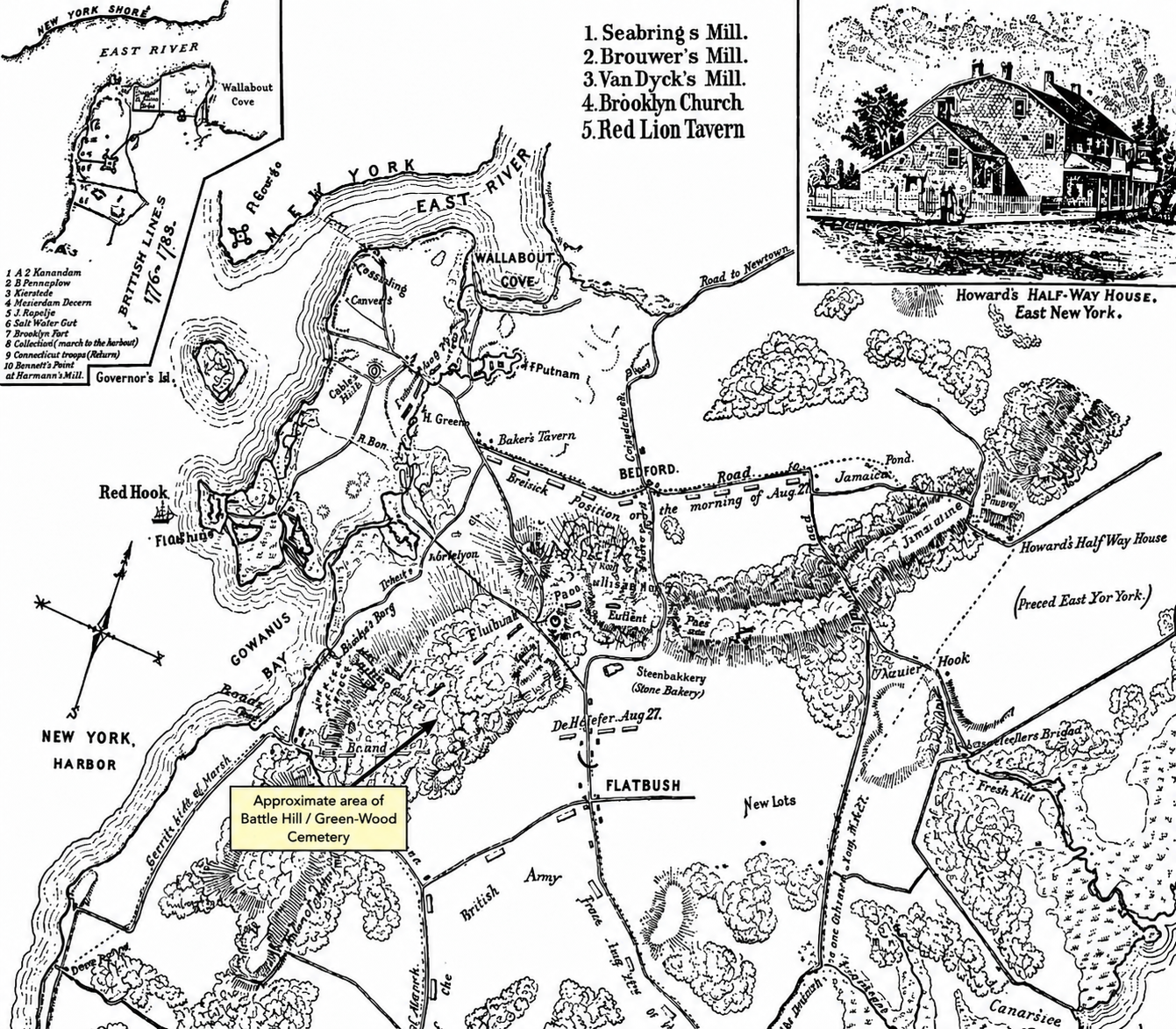
Map of the Battle of Brooklyn, August 27, 1776. Cropped and annotated detail from Henry R. Stiles, The Civil, Political, Professional and Ecclesiastical History and Commercial and Industrial Record of the County of Kings and the City of Brooklyn, N.Y., vol. 1, New York, 1884. The map shows the battlefield geography of Brooklyn, Gowanus, Flatbush, Bedford, and Jamaica Pass, the setting for the fighting on Battle Hill discussed by J. Michael Phelps. Cropping, contrast enhancement, and annotation by the American Revolution Institute.
Your article argues that the Battle of Brooklyn has been “only half covered” by most historians. What do you mean by that, and what part of the story has been missing?
For the first 100 years after the battle, historians focused solely on the brave stand by Gen. William Alexander (Lord Stirling) and the Maryland 400 against the British which started about noon at the Vechte-Cortelyou House (“Old Stone House”). During that period, there was not a single mention by historians of the fighting on Battle Hill involving Continental Army General Samuel H. Parsons and his force, comprised primarily of the 17th Connecticut Continental Regiment. It was not until 1878, when Henry Phelps Johnston published his Campaign of 1776 Around New York and Brooklyn, that details of “the other half” of the battle started to emerge. Johnston unequivocally declared “That little party composed of Atlee’s and Huntington’s battalions under General Parsons… must not be forgotten. Our published accounts heretofore fail to particularize the service it did; but it was of no small account.”
However, most subsequent historians describing the battle ignored Johnston’s praise of Parsons and the 17th Regiment and continued to focus solely on the Maryland 400. For the past 250 years, with a few notable exceptions such as Charles S. Hall’s Life and Letters of Samuel Holden Parsons (1905), Eric Manders’s well-researched Battle of Long Island (1978) and Charles H. Lewis’s Cut Off (2009), historians have, for the most part, overlooked, or barely mentioned, the fierce fighting which took place on Battle Hill, which started around 8:30 AM and lasted until a few hours after noon. The number of troops from both sides who were engaged on Battle Hill was at least as large as the number at the Old Stone House. The fighting on Battle Hill also lasted for a longer period of time than the action involving the Maryland 400. Moreover, as discussed below, the British suffered far more casualties on Battle Hill than any other location over the entire battlefield. Alas, despite the clear significance of Battle Hill, the firefights there by Parsons and the 17th Regiment have remained mostly ignored by most historians, even today. Although the Maryland 400 continues to fully deserve all of the praise it has received for its bravery and sacrifice, the commensurate valor by Parsons and the 17th Connecticut Continental Regiment deserves equal attention.
Why was Battle Hill so important on August 27, 1776, and what happened there during the fighting?
Battle Hill was crucial because it was the highest point in Brooklyn and had a commanding view of the entire battlefield. Continental Army General Samuel H. Parsons (leading a force primarily comprised of the 17th Connecticut Continental Regiment) had been ordered to capture the summit. This was the first actual combat in which Parsons’s men ever had been engaged. After an initial unsuccessful attempt, they captured Battle Hill with their second attack. Then, over a period of about three hours, they drove back three ferocious British counterattacks. The British suffered more casualties on Battle Hill than any other place on the entire battlefield, more than 40% of their killed in action. In contrast, very few British were killed at the Vechte-Cortelyou House. After holding the Battle Hill summit for the entire morning, around noon Parsons’s men became surrounded through no fault of their own after the British marched 10,000 men around the distant Jamaica Pass. Despite battling desperately, escape was nearly impossible, and more than 80% of Parsons’s men were captured.
In his Campaign of 1776, Henry Phelps Johnston recognized the key contribution by Parsons and the 17th Regiment as follows: “Thus bravely and effectively had this small body of Americans protected Stirling’s flank and dealt the enemy the severest blows they had suffered at any one point during the day” He also noted: “The four regiments alone which at different times encountered Parsons—the Seventeenth, Twenty-Third, Forty-fourth, and Forty-Second—lost in the aggregate eighty-six officers and men killed and wounded.”
As the Maryland 400 later did at the Old Stone House, Parsons and the 17th Regiment helped protect Stirling’s flank from British attacks, thereby helping to save the lives of the many Patriots who were able to escape to the safety of the Brooklyn fortifications. In doing so, the troops on Battle Hill inflicted heavier losses on the British than anywhere else during the entire battle.
Your work restores attention to General Samuel H. Parsons and the 17th Connecticut Continental Regiment. Why have they been so easy to overlook, and what evidence convinced you that their role was central?
One factor causing Parsons and the 17th Connecticut Continental Regiment to be ignored was that they literally were out of sight, out of mind, because the action on Battle Hill was at such an elevation and distance that it was not visible from the Patriot fortifications in downtown Brooklyn. In contrast, Stirling and the Maryland 400 were fighting near the Vechte-Cortelyou House, which was much closer and readily visible to Gen. Washington and the officers behind the American works. Within a short time, various newspapers carried descriptions of the fighting at the Old Stone House, and the story of the Maryland 400 was widely disseminated throughout the fledgling country.
Another factor why Parsons and his men were never discussed is that more than 80% of the officers and men from the 17th Regiment were captured so none of them were available to describe the furious fighting on Battle Hill. Furthermore, with the exception of Jabez Fitch (whose New York Diary was not published until 1954 and only described the battle in very sparse detail), none of the officers from the 17th Regiment ever wrote about what happened on Battle Hill. In contrast, not long after the battle Maryland Regiment Colonel William Smallwood wrote a lengthy letter in which he described how Lord Stirling led the Marylanders against the British Generals Cornwallis and Grant. Likewise, several other Maryland officers wrote letters immediately after the battle describing the bravery of the troops under Stirling at the Vechte-Cortelyou House. Thus, the bravery of the Marylanders was extolled while the valor of Parsons and the 17th Regiment was almost universally overlooked.
The first evidence of the significant role played by Parsons and the 17th Regiment did not appear until 1848, when Peter Force published his monumental American Archives series containing transcripts of numerous letters from 1776 where the action on Battle Hill was described. Among the most important new pieces of evidence about Battle Hill which was published in American Archives was the Journal written by Col. Samuel J. Atlee, the head of the Pennsylvania Musketry Regiment. (Actually, the first version of Atlee’s Journal had been published in 1847 in The Life and Correspondence of Joseph Reed, but it received very little notice.) Atlee provided a detailed description of the fighting on Battle Hill, including the initial unsuccessful assault, the capture of the summit by the Americans, and the defeat of three British counterattacks. Regrettably, Atlee’s Journal was written in a manner which was strongly biased in favor of his own Pennsylvania troops and minimizing the role played by Parsons and the 17th Regiment. In fact, Atlee’s Journal falsely implied that he, not the higher-ranking General Parsons, was in command of all the troops on Battle Hill. It was not until Johnston’s Campaign of 1776 published in 1878 that the August 29, 1776, and October 8, 1776, letters from Gen. Parsons to John Adams became publicly available. Those letters clearly showed that Parsons was in command on Battle Hill, giving orders to Atlee, not vice versa. With the 1978 publication of Manders’s Battle of Long Island all of the details of the fighting on Battle Hill, including the crucial role played by Parsons and the 17th became crystal clear. Unfortunately, even after the publication of Manders’s book, most historians continued to focus only on the Maryland 400 at the Old Stone House and to ignore Parsons and the 17th Regiment. Thus, in an effort to finally tell the full story of the Battle of Brooklyn, I published Squandered Valor to try to set the record straight once and for all.
The title Squandered Valor is powerful. What does that phrase mean to you, and why is it important to tell this story now, as the 250th anniversary of the Battle of Brooklyn approaches?
It is beyond question that the officers and men of the 17th Regiment fought with exemplary valor on August 27, 1776, despite the fact that was the first time any of them had engaged in active combat and the fact that they were outnumbered by a force of seasoned British regulars. Parsons’s troops were ordered to capture the summit, and did so. They were ordered to retain possession of that vital high ground until ordered to retreat, and they did that as well. In the ferocious firefights that took place on Battle Hill, they drove back three counterattacks and inflicted more casualties on the British than anywhere else on the entire battlefield. In fact, despite their lack of prior battlefield experience, they bravely held their ground against the Redcoats for nearly three hours. The fact that they became surrounded by an overwhelming enemy force, through the fault of others that left the distant Jamaica Pass essentially unguarded, does not diminish their accomplishments. Although their valor was squandered due to the negligence of others, we owe it to them to spread their story far and wide and raise the level of attention to their role to the same level as the Maryland 400. As we near the 250th anniversary of the battle, it is especially important for us to do so. We owe it to all of the officers and men from both Maryland and Connecticut to remember their bravery and sacrifice.
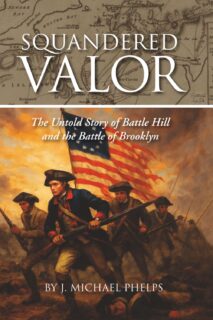
We thank J. Michael Phelps for discussing Squandered Valor and for helping bring renewed attention to Battle Hill, General Samuel H. Parsons, and the 17th Connecticut Continental Regiment in the Battle of Brooklyn. Readers interested in learning more about Battle Hill, General Samuel H. Parsons, the 17th Connecticut Continental Regiment, and the fuller story of the Battle of Brooklyn can find J. Michael Phelps’s book, Squandered Valor: The Untold Story of Battle Hill and the Battle of Brooklyn, available for purchase on Amazon: https://www.amazon.com/Squandered-Valor-Untold-Battle-Brooklyn/dp/B0H575NF5P
About the Library
The research library of the American Revolution Institute houses more than fifty thousand rare books, manuscripts, prints, broadsides, maps and modern reference sources, and is one of the most important resources in the world for advanced study on the Revolution. The library welcomes researchers to use the collections by appointment and supports scholarship by offering several research fellowships each year to graduate students and advanced scholars. To learn more, and make an appointment click here.