Brock Beaver (Dorchester District 2), Summerville, South Carolina
DESIGN LEVEL: Middle-High School
Overview
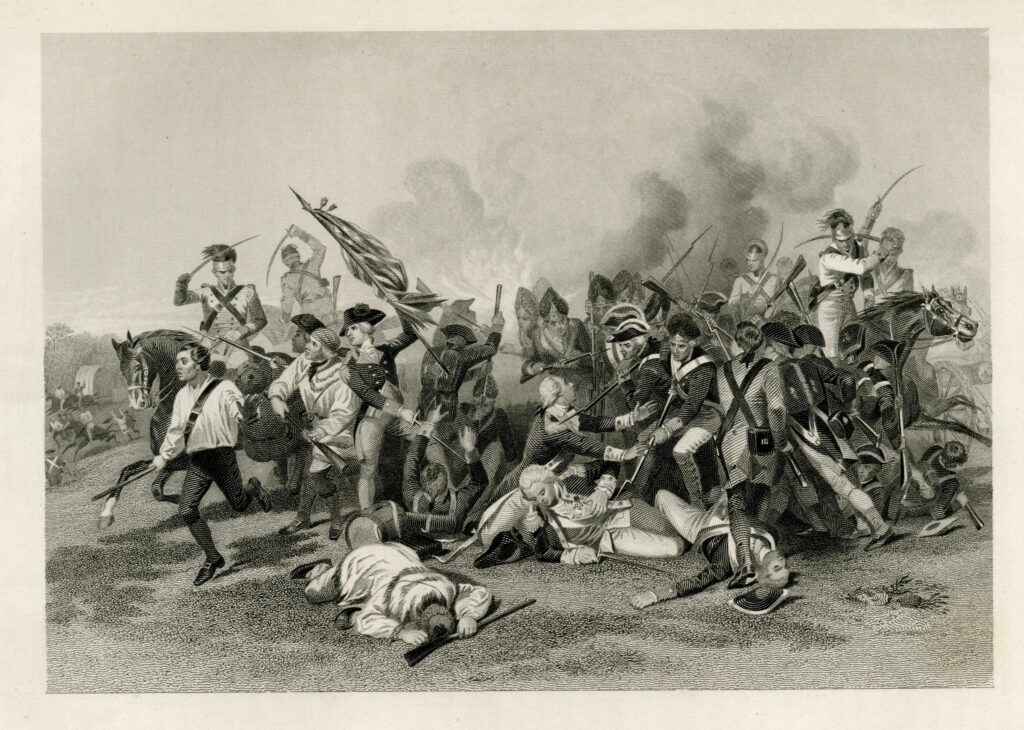
The British strategy to split forces and launch a Southern Campaign hoped to include more Loyalists and capture valuable ports. General Horatio Gates, newly appointed U.S. commander of the Southern Department, prepared to face the British forces of General Cornwallis in Camden, South Carolina, in the summer of 1780. General Gates marched his Continental forces with militia from Maryland, Virginia, and North Carolina south, believing he could defeat the outnumbered forces of Cornwallis in traditional European-style battle. This disastrous decision would prove to be the turning point in the Southern Campaign, and the aftermath witnessed an emerging American style of battle that would challenge the core of the British regular forces. This lesson is designed to analyze the difference in “European” warfare and “American” strategy, and highlight the emergence of an independent, American identity.
Objectives
Students will:
- Demonstrate an understanding of the motivations to fight in the American Revolution for both loyalists and patriots.
- Understand how Nathanael Greene’s reliance on South Carolina militia greatly differed from prior commanders during the Southern Campaign of the American Revolution.
- Analyze how an American identity revealed itself through guerilla warfare in South Carolina following the Battle of Camden.
Essential Question
1. What decisions led to the American defeat at the Battle of Camden?
2. How did American General Horatio Gates view the role of militia in warfare?
3. How did American General Nathanael Greene view the role of militia in warfare?
4. Why would General Greene support unconventional tactics in warfare throughout South Carolina?
5. How does the Southern Campaign in South Carolina reflect a uniquely American identity during the American Revolution?
Materials
- Battle of Camden–Death of DeKalb, engraved by Alonzo Chappel. New York (N.Y.): Johnson, Fry & Co., c. 1857. The Society of the Cincinnati, The Robert Charles Lawrence Fergusson Collection.
- Jethro Sumner, A.L.S. Warren [County, North Carolina], 20th July, 1780: to General Horatio Gates. The Society of the Cincinnati.
- Gen. Thos. Sumter, 10th August, 1780: to Major Gen. Gates. Colonial and State Records of North Carolina.
- South-Carolina and Parts Adjacent, Isaac Collins and David Ramsay. London: 1785. Harvard Library, Harvard Map Collection [ARGO].
- “I am certain they will desert…” Primary Source Excerpt from Lt. Col. Francis Marion’s Report to Maj. Gen. Horatio Gates on the Battle of Great Savannah. Ports Ferry, N. Side Pedee, 29th August 1780. American Battlefield Trust.
- The Battle of Camden: August 16,1780. National Park Service.
- Walter Edgar, The South in the American Revolution, Part 5 of 8: Battle of Camden, Frances Marion and Guerilla Warfare, January 4, 2013. The American Revolution Institute.
- Alexander Hamilton, 6 September 1780: to James Duane. National Archives and Records Administration, Founders Online.
- Gen. Nath. Greene, 28th December 1780: to Gen. George Washington. Colonial and State Records of North Carolina.
- General Sumner, 25th February 1781: to General Greene. Colonial and State Records of North Carolina.
- Gen. Nath. Greene, 19th April 1781: to General Sumner. Colonial and State Records of North Carolina.
- Francis Marion, 30th December 1781: to Nathanael Greene. The Charleston Museum Archives.
- George Washington, 6th February 1783: to Nathanael Greene. National Archives and Records Administration, Founders Online.
- “DOCUMENTS A-K”—Teacher-Created Source Appendix for Lesson
Recommended Time
Two 60-minute class periods.
Lesson Activities
BACKGROUND:
Students should be familiar with the early stages of the Revolutionary War and the pitched battles between British regulars and Continental soldiers (e.g., Saratoga, Brandywine, Monmouth).
British troops forced the majority of the American southern command to surrender after the fall of Charles Town [Charleston], South Carolina, in May of 1780. Congress sent General Horatio Gates to command the remnants of the southern American army. In three months, the Battle of Camden would prove to be one of the worst disasters in the American Revolution for the Patriot cause, but it would also serve as a turning point in the Southern Campaign, and the entire war.
Throughout the lesson, reference the ARGO map titled: South-Carolina and Parts Adjacent.
DAY 1:
Intro Activity—
Remind students that many foreign individuals volunteered for the American cause, like the marquis de Lafayette and Johann de Kalb. Explain that the Battle of Camden was one of the worst American defeats of the war, and one that witnessed the death of Baron de Kalb. Display the engraving Battle of Camden-Death of de Kalb. Ask students to analyze the engraving and list as many details as possible. Pose these questions for discussion: Why would an artist with limited resources and time choose to depict this image of the Battle of Camden? What would you think of joining the American cause after this battle?
Small Groups—
Divide students into pairs or groups of three. Distribute Jethro Sumner’s 20 July 1780 letter to Horatio Gates and Thomas Sumter’s 10 August 1780 letter to Horatio Gates. Ask students to read the letters as though they are General Gates. With guidance, students should summarize the letters as best they can, then, based upon what they read, decide if General Gates should engage the British forces in battle. If not, students should describe what General Gates should do.
After students have had time to summarize the letters and reflect on their decisions, disband the groups. As a class, discuss the actions Gates should take.
Whole Group—
Instruct students about he Battle of Camden and its disastrous results. Show the video clip from Professor Walter Edgar on the Battle of Camden and the actions of Francis Marion. Following the video, lead a discussion with students about the difference in the approach of General Gates as opposed to the tactics of Francis Marion and other southern militia commanders.
Closure and Reflection—
Distribute the 29 August 1780 letter from Francis Marion to Horatio Gates. Remind students that Marion wrote the letter almost two weeks after the Battle of Camden. Prior to reading, ask students to identify Marion’s tone, and have students think about the difference between Marion and Gates. Read the document with students and model your thoughts and questions as you read. After reading the document as a class, ask students which commander they would follow. Have student support their answer with evidence from the day’s lesson.
DAY 2:
Intro Activity—
Briefly review the lesson from Day 1. Lead a discussion with students about what next actions they believe should be taken by the American southern command. As a whole class, read the reaction of Alexander Hamilton on the Battle of Camden contained in his 6 September 1780 letter to James Duane. Ask students to reflect on Hamilton’s overall reaction, then ask students why they believe Hamilton had such a strong reaction? Follow up by asking what Hamilton proposes in response to the defeat at Camden.
Small Groups—
Divide students into groups of three or four and assign one of the following letters to each group. Some of these may be duplicated depending on class size.
- Nathanael Greene to George Washington, December 28, 1780 (excerpt 1);
- Nathanael Greene to George Washington, December 28, 1780 (excerpt 2);
- Jethro Sumner to Nathanael Greene, February 25, 1781;
- Nathanael Greene to Jethro Sumner, April 19, 1781;
- Francis Marion to Nathanael Greene, December 30, 1781.
In these groups, ask students to complete the following tasks (with guidance if necessary).
1. Summarize the letter using sourcing skills and the context of the Southern Campaign.
2. What challenges does the author face?
3. Why is this letter important in the larger context of the War?
4. How does this letter compare to sources created prior to the Battle of Camden?
After the groups have discussed their letters, have each group brief the class. After each group’s presentation, invite students to ask questions of the group.
ASSESSMENT
As a class, read the February 6, 1783, letter from George Washington to Nathanael Greene. Ask students to complete a reflection on how Washington identifies an emerging America, and to what extent Nathanael Greene’s command during the Southern Campaign helped secure American victory in the Revolutionary War.
OPTIONAL EXTENSION ACTIVITIES:
- Explore the actions of southern militia leaders, i.e., Francis Marion, Andrew Pickens, and Thomas Sumter.
- Study the strategies used by Daniel Morgan in the Battle of Cowpens.
- Analyze the causes and consequences of the Battle of Guildford Courthouse.
- Trace the path to Yorktown, and the surrender of Cornwallis.
Standards Addressed
SOUTH CAROLINA COLLEGE- AND CAREER-READY STANDARDS FOR SOCIAL STUDIES
Grade 8: South Carolina and the United States
8.2.CO (Comparison): “Compare the motives and demographics of loyalists and patriots within South Carolina and the colonies.”
8.2.CE (Causation): “Explain the economic, political, and social factors surrounding the American Revolution.”
8.2.CX (Context): “Contextualize the roles of various groups of South Carolinians as the colonies moved toward becoming an independent nation.”
8.2.E (Evidence): “Utilize a variety of primary and secondary sources to analyze multiple perspectives on the development of democracy in South Carolina and the United States.”