Supporting scholarship and promoting popular understanding of the American Revolution is central to the work of the American Revolution Institute. The Institute welcomes distinguished scholars and authors to share their insights and discuss their latest research with the public at Anderson House through lectures, author's talks and panel discussions. The Institute also hosts a variety of other historical programs throughout the year, including our Lunch Bite object talks, battlefield tours, special Anderson House tour programs and other events. Many of the events we offer are free.

August 2025
Lunch Bite—A Recruiting Broadside For the Continental Navy Ship Columbus
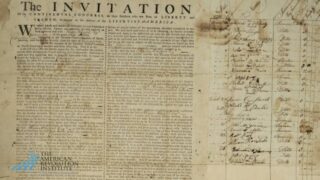
The Institute's research services librarian, Rachel Nellis, discusses a 1775 recruitment broadside laying out the terms and benefits of enlistment for sailors on the Columbus, commanded by Abraham Whipple. This presentation will discuss the use of broadsides in the Revolutionary era, the terms of enlistment for sailors, Capt. Abraham Whipple, and the various signers of the broadside. Registration is requested. To attend the Lunch Bite in-person at Anderson House, or to watch virtually, please use the appropriate link below.
Find out more »October 2025
Virtual Lunch Bite—A Portrait of Continental Navy Officer Silas Talbot
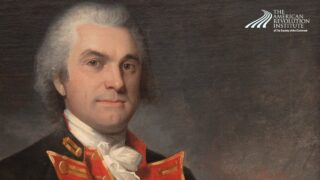
The Institute’s museum collections and operations manager, Paul Newman, discusses a 1785 portrait of Continental Navy officer Silas Talbot, painted by Ralph Earl. Though he was born in Massachusetts, Silas Talbot first took up arms against the British for his adopted state of Rhode Island in 1775. As a captain in the militia, Talbot first served at the Siege of Boston before being commissioned into the Continental Army and later tasked with creating and launching a fireship against British vessels…
Find out more »December 2025
Virtual Lunch Bite—The Revolution’s First Winter: Loyalist Thomas Ainslie’s Account of the 1775 American Assault of Quebec
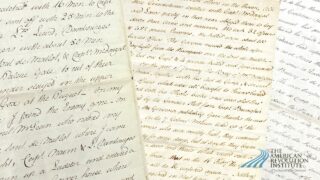
The Institute’s library director, Thomas Lannon, discusses the American invasion of Canada during the first winter of the Revolution and the failed attempt to capture Quebec to rally support against Britain and bring Canada into the rebellion as the hoped-for “fourteenth colony.” With unrest spreading in the southern colonies, British leaders worried rebellion might cross into Canada. That fear was justified and Canada figured prominently in the American strategy for an opening campaign in the Revolution. Congress authorized the invasion in…
Find out more »February 2026
Virtual Lunch Bite— British Officer Thomas Musgrave’s Account of the American Revolution
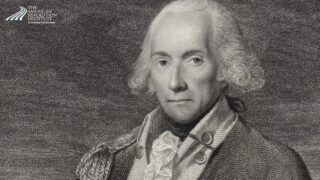
Join the Institute’s museum collections and operations manager, Paul Newman, for a discussion of a 1780s manuscript account of the American Revolution by Lt. Col. (later made a General and Baronet) Thomas Musgrave, a British officer who served extensively throughout the war. At the battle of Germantown, he commanded the British 40th Regiment of Foot that famously defended the Chew House against attacking American forces. Subsequently, he was restationed in the West Indies in 1778, before returning to New York…
Find out more »April 2026
Virtual Lunch Bite—Thomas Paine’s Common Sense
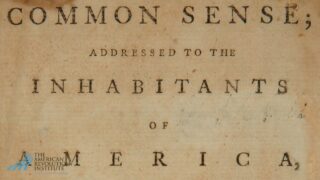
Join the Institute’s library director, Thomas Lannon, to examine one of the most important pamphlets in American history that reshaped the political imagination of British North America: Thomas Paine’s Common Sense, published in January 1776. Written in direct, accessible language, it challenged monarchy, argued for independence and urged ordinary readers to see themselves as agents of historical change. This Lunch Bite marks the 250th anniversary of Common Sense by exploring how Paine’s words circulated, why they resonated so powerfully in…
Find out more »